Importing Image Sequences for Video Conversion
Learn how to import image sequence folders into RenderGod to convert them into video files. This feature is perfect for creating video files from rendered frame
Importing Image Sequences for Video Conversion
Learn how to import image sequence folders into RenderGod to convert them into video files. This feature is perfect for creating video files from rendered frames, animation sequences, or extracted video frames.
Overview
RenderGod can convert image sequences (folders containing numbered image files) into video files. This is essential for:
- Final output: Convert rendered animation frames into video files
- Video creation: Assemble image sequences into playable video formats
- Format conversion: Change image sequence formats into video formats
- Delivery: Create video files for client delivery or distribution
Supported Image Formats
RenderGod supports all common image sequence formats:
- PNG (with or without alpha channel)
- JPEG/JPG
- EXR (various compression methods)
- TIFF
- And other formats supported by FFmpeg
Image Sequence Requirements
For proper conversion, your image sequence should:
- Be in a single folder: All images must be in one directory
- Have sequential numbering: Files should be numbered sequentially (e.g., `001.png`, `002.png`, `003.png`)
- Use consistent naming: Maintain consistent file naming throughout the sequence
- Be complete: Ensure no frames are missing from the sequence
Import Methods
You have two convenient ways to import image sequence folders:
Method 1: Drag and Drop
The simplest method for importing image sequences.
- Open Windows File Explorer
- Navigate to your image sequence folder
- Drag the entire folder from File Explorer
- Drop it onto the RenderGod application window
- The image sequence will be automatically added to your queue as an "Image Sequence to Video" job
Important: Drag the entire folder, not individual image files. RenderGod needs the folder structure to process the sequence.
Method 2: Import Button
Use the import button for folder selection.
When Queue is Empty
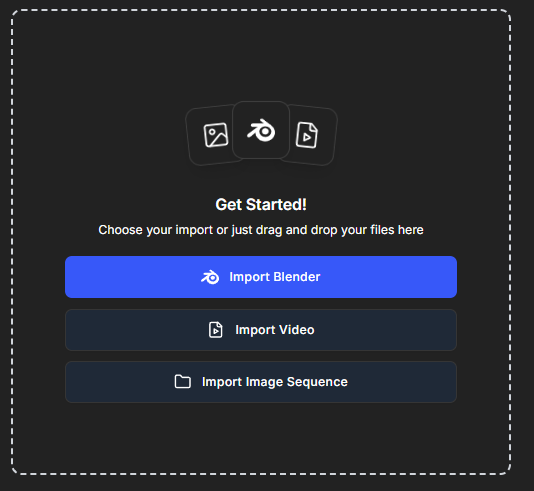
When your render queue is empty, you'll see import buttons in the center of the screen.
- Click the "Import Image Sequence" button
- A folder selection dialog will open
- Navigate to your image sequence folder
- Select the folder containing your images
- Click "Select Folder" to add it to the queue
When Queue Has Items
When your queue already contains items, locate the import buttons in the bottom-left panel.
- Find the "Import Image Sequence" button in the bottom-left corner
- Click the button
- Select your image sequence folder from the dialog
- The folder will be added to the end of your queue

Job Configuration
After importing an image sequence folder, a new job card appears in your queue with these configurable options:
Video Format (Encoding)
Choose the video codec and format for your output:
- ProRes 422HQ: High quality, professional format (large file size)
- ProRes 422: Standard ProRes format (good quality, smaller than 422HQ)
- H.264 16Mbps: High quality H.264 encoding (good balance)
- H.264 50Mbps: Higher bitrate H.264 (better quality)
- H.264 Web Optimized: Optimized for web delivery (smaller file size)
Recommendation: Use ProRes for professional workflows, H.264 for general use, and Web Optimized for online distribution.
Frame Rate (FPS)
Set the frame rate for your output video:
- Auto-detect: RenderGod can attempt to detect FPS from file naming
- Manual entry: Enter your desired frame rate (common values: 24, 25, 30, 60 fps)
- Default: Uses default FPS setting from your preferences
Tip: Match the frame rate to your original animation or project settings for proper playback speed.
Output Location
Configure where your video file will be saved:
- Default: Saves in the same folder as the image sequence
- Custom: Specify a different output location
- File naming: The output video uses the folder name or a custom name you specify
Default Settings
Configure default settings for image sequence to video conversion:
- Go to Settings > Default Settings
- Find the Image Sequence to Video section
- Set your preferred default video format
- Configure default frame rate
- Set default output location behavior
These defaults apply to all new imports, but you can customize each job individually.
Best Practices
Before Importing
- Verify sequence completeness: Ensure all frames are present and numbered correctly
- Check image format: Verify all images use the same format
- Organize folder: Ensure the folder contains only the sequence images (no other files)
After Importing
- Review video format: Select the appropriate format for your use case
- Set frame rate: Ensure the FPS matches your project requirements
- Check output path: Verify where the video will be saved
Workflow Example
A typical workflow for image sequence to video conversion:
- Render frames in Blender (or another application) as an image sequence
- Import folder into RenderGod using drag and drop or the import button
- Configure settings - Select video format and frame rate
- Start conversion - Click the start button to create your video
- Access video - Find your completed video in the output location
Output File
After conversion, you'll have:
- Single video file: All frames combined into one video file
- Proper frame rate: Video plays at the correct speed
- Selected format: Video uses your chosen codec and settings
- Ready for use: Video is ready for playback, editing, or distribution
Related Features
- Auto Image Sequence to Video: Automatically convert Blender renders to video
- Video to Image Sequence: Convert videos back to image sequences
- Default Settings: Configure default formats and frame rates
- Queue Management: Process multiple conversions efficiently
Troubleshooting
Sequence Not Importing
- Check folder structure: Ensure you're importing the folder, not individual files
- Verify numbering: Make sure files are numbered sequentially
- Check permissions: Ensure RenderGod has read access to the folder
Conversion Issues
- Frame rate: Verify the frame rate matches your sequence
- Format compatibility: Try a different video format if one doesn't work
- Disk space: Ensure you have enough space for the output video file
Your image sequences are now ready to be converted to video files!

© 2026 RenderGod. All rights reserved.